Background:
The National Party came to power in South Africa in 1948, bringing with them a policy of apartheid: the separate development of the races within the country. This led to extreme repression of non-white citizen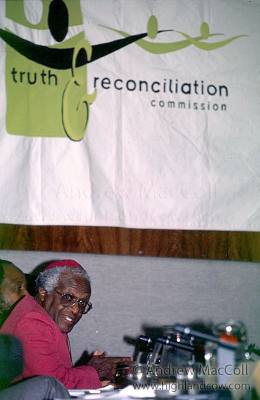 s, and ongoing violent conflict between the state’s security apparatus and resistance movements; the most well-known being the African National Congress (ANC) led by Nelson Mandela. In 1994 the first free, multi-racial elections were held, spelling the end of discriminatory apartheid rule, and ushering in the first black majority-government.
Excerpt From the 2008 Residential Report (for full report click here):
The Truth & Reconciliation Commission was rooted in the amnesty provisions decided during negotiations. The provisions of this amnesty made clear that it would only be granted if perpetrators fully disclosed the truth about all details of political crimes and that no apology was necessary. An additional victim component focused on story telling and acknowledgment. To a large extent the TRC was appointed to make reparations recommendations and broader preventative recommendations to aid in the process of reconciliation.
Web links
The official website of the South African Truth and Reconciliation Commission
www.doj.gov.za/trc/trc_frameset.htm
Centre for the Study of Violence and Reconciliation
www.csvr.org.za
Institute for Justice and Reconciliation - A cluster of community based projects aimed at targeting participants that represent different levels of their society thus ensuring an inclusive approach to memory and healing.
http://www.ijr.org.za/recon-recon/memoryhealing
Dr Brandon Hamber’s website contains conference papers, newspaper, academic journal articles and research reports that deal extensively in issues related to dealing with the past in South Africa
www.brandonhamber.com
Excerpt From the 2008 Residential Report:
The TRC reported on the causes, nature and extent of violence in October 1998. Its report was 3,500 pages (amounting to some five volumes); two more volumes were added in 2003. The report made recommendations to prevent future violence and to give victims reparations (October 1998). Yet reparations only came in April 2003; which amounted to a once-off final reparations grant of R30,000 (US$4,200) to some 19,000 people.
Started in December 1995, the amnesty component of the TRC was completed in 2003. Some 20,000 people made statements about violations, and around1,800 had public hearings. About 7,100 amnesty applications were made in total, with around 1,100 granted and 5,000 refused.
Steve Biko Foundation including a biography of his life.
www.sbf.org.za
Information and listings of biographies from those involved in the anti-apartheid struggle.
www.southafrica.info/about/history/strugglebiography.htm
IDEA - A downloadable handbook on reconciliations after violent conflict that considers the workings of the South African TRC.
http://www.idea.int/publications/reconciliation/upload/reconciliation_full.pdf
Excerpt From the 2008 Residential Report:
The South African participants pointed out that ‘few long-term structures for reconciliation’ existed. A reparations body was not put in place, which led to the feeling of ‘unfinished business’; there were also a number of administrative problems in the support of victims; and the complexity of story-telling was also an important issue. The participants argued that a truth commission may be a necessary first step toward individual psychological healing but is, in itself, insufficient to meet all psychological needs. In many ways the TRC ‘initiated more than it closed’. It was argued that ‘integrating processes’ (or a ‘structured approach’) was probably the better way to proceed.
Article links
International Committee of the Red Cross (ICRC) - This article sets out guiding principles and looks at the circumstances in which a truth and reconciliation commission constitutes an appropriate instrument to deal with transitional justice issues.
www.icrc.org/web/eng/siteeng0.nsf/htmlall/review-862-p311?OpenDocument&style=custo_print
A discussion, including background, of the operations of the Truth and Reconciliation Commission
http://web.africa.ufl.edu/asq/v4/v4i3a2.htm
Centre for the Study of Violence and Reconciliation - A discussion on dealing with the past and the psychology of reconciliation in South Africa.
www.csvr.org.za/index.php?option=com_content&task=view&id=738&Itemid=13
A short review to a recent book examining whether or not the TRC delivered truth and reconciliation to South Africa
www.upenn.edu/pennpress/book/14370.html
Excerpt From the 2008 Residential Report:
The purpose of the TRC was to establish a broad truth and record it for posterity. Overall it created ‘windows of opportunity’ and sought a reduction of ‘denialism’ (‘narrowed permissible lies’ according to Michael Ignatieff).


 Dealing with the Past Internationally: South Africa


